Showing posts with label maintaining momentum. Show all posts

Friday, June 20, 2008

The meaning and uses of failure

etching 117mm x 92mm
It is so easy to get stopped in one's tracks by failure. Yet as JK Rowling and many other successful and talented people have pointed out, failure has its own particular benefits and being willing to risk and engage with failure is vital to any creative endeavour.

I was both moved to tears and inspired by JK Rowling in her wonderful Harvard commencement address in which she explained that failing on an epic scale had stripped away the inessential leaving her to put all her energy into the one thing she was good at. (Thanks to Christine Kane for alerting me to this goodie)

Many wise teachers have understood the importance of not being afraid to fail. Among them, Randy Pausch, when he was virtual reality tutor at Carnegie Mellon, gave his students the First Penguin Award for the most spectacular failure - an award the other students knew was an honour for daring to think outside the box.

In a Recipe for Dreaming, Bryce Courteney writes, "you will learn more from a brilliantly executed failure than from a success planned within the dreary safety of what you already know."

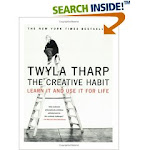
Twyla Tharp in her book The Creative Habit writes a whole chapter on failure. Like Rowling she says failure "cleanses. It helps you to put aside who you aren't and reminds you who you are."

In a useful exercise Tharp breaks down failure into five categories - it's worth reading the whole chapter, but here is a precis:

1. Failure of skill > take the time and make the effort to develop the skills you need.
2. Failure of concept > start again
3. Failure of judgement > be wary of telling yourself - it's just fine - when you know in your gut it isn't.
4. Failure of nerve > let go of the fear of looking foolish.
5. Failure through repetition > don't try and repeat past successes - allow yourself to move on.

My own epiphany with failure came when I realised the importance of scaffolding. After a house has been built, the scaffolding is removed, you don't see it -  and yet it was an essential part of the process. Likewise, ecologists trying to restore, say a wild prairie, are running into difficulties because certain species have disappeared completely and yet they were essential to arriving at the final ecosystem. From the individual species point of view, this is failing - looking at the bigger picture, they were part of the scaffolding that led to the wild prairie. Failure is scaffolding. 

This partly explains why comparison with other artists can be deadly. When I look at someone else's creative success what I don't see are the failures it took to get there. Now, when I try new things out in the studio, or in my writing, I avoid thinking - this is the final thing, this has got to work or, this is going to be the great success. I approach it like this - so, I've got a hunch to do it this way and it seems maybe a little odd or at least unexpected, but I'm going to trust myself and try it out because even if it doesn't work, who knows where it will lead? 

If I look at my favorite pages in the picture book I'm working on, they are all a third or fourth try and I wouldn't have got there if I hadn't had those 'failures' to build upon along the way. I've also tried picture books before and 'failed'. There are at least half a dozen starts in boxes and sketchbooks that didn't work out. Yet now I see that many of the ideas contained in those 'failures' are essential to this project which is coming together in a way I'm really happy about.

Failure is scaffolding, it means you are building something, trying things out, learning what works for you and what doesn't. The important thing is not the 'failure', it's using the lesson contained within to take the next step.


Wednesday, June 11, 2008

When the inspiration is stuck - it's time to move your body


Some days everything flows and other days I feel like there are invisible brick walls in my head. After innumerable false starts, I give up and go for a walk. What a relief to finally feel a sense of unimpeded movement. Whilst the walls of the studio felt like they were closing in on me, now I am outside with a wide horizon, distant hills and the sound of birds busy about their day; a grey heron stalks fish in the estuary, a kingfisher dives into the deep channel and emerges with his catch, a tui sings from the bottle brush tree. 

After a brisk walk in the crisp air - feeling the welcome sunshine on my skin (because this is New Zealand and it's a chilly winter this year) and having my attention absorbed by the natural world around me - things inside are becoming unstuck. Characters deliver up lines of dialogue and a new and dynamic scene unfolds itself. On the picture book front I feel renewed energy and belief in my current page - so what if embroidery thread broccoli is taking days to do - it will be worth it.  Taking a walk outside helps me to settle into my natural rhythms, it shakes out the grumps, gives me a wider perspective and so, feeling refreshed and at peace with myself, I am once more ready to do the work that calls me.

Monday, June 2, 2008

Frenetic Haste vs Procrastination

A bath in time saves nine - etching

Back at work in my studio, I am aware of an urge to hurry.  'Come on,' cries a voice in my head. 'This is taking too long. Nothing's happening!' Ironically, this exhortation to work quickly, slows me down almost to a stop. The sense of restless impatience makes it impossible to sink into the work, to feel where it wants to go. 

Sometimes, I fall into the opposite trap - procrastination, when I know what to do next, but cannot galvanize myself to do it and instead go into slow motion, staring at the work for long periods of time or else distracting myself with unimportant chores.

Working with active imagination techniques it becomes clear the root cause of both problems is the same - wanting the work to be good, more than good, wanting it to be wonderful, amazing, to be successful and admired.

Now, you might say, who doesn't? Isn't it good to be ambitious, to want to be the best you can be? Aren't these the goals we set our children?

True, but as Caroline Myss says, in order to create anything we have to keep our spirit in present time. Only in present time can I be with the work as it is now, can I feel the next step as the work evolves. 

The frenetic haste or procrastination is caused by my leaping ahead to a fantasy about how the work will be received - the desire for glory or the fear of ridicule. The trick is to find my way back into that delicious state of absorption where I am not aware of any separation between the work I am creating and myself.

One physical way back into present time is to use the breath, as my yoga teacher constantly reminds me, breathe into the back of your heart, or as my dear craniosacral therapist partner says, breathe into your belly. 

I also know that the only way to sustain this creation is to let go of my ego's need for praise and it's fear of criticism and to allow my artist soul to get on with doing the work for the work's sake. 'To let it be,' as Clarissa Pinkola Este's says, ' just what it is.' 


Wednesday, May 28, 2008

How to revive a creative project when it has gone stale

The energy was flowing on my latest project - a children's picture book - when I had to take a week off to go to the city. The city was great, I saw some intriguing art and had a great time with my friends. I arrived home eager to get back to my picture book, but to my dismay I found the energy had gone flat. What to do?

I remembered a great story that addresses this issue from Clarissa Pinkola Estes called the Three Golden Hairs. In the story an old man collapses across the hearth of a cottage. The woman inside takes him onto her lap and rocks him all night long. As she rocks and comforts the man, he grows younger until by daybreak he is a golden haired child. The woman then plucks out three of the child's golden hairs and throws them on the floor, ting, ting, ting.

So there was my teaching story, but what to do about my project? I decided the rocking could mean just spending time with it, not trying to do anything, just being with the work I had already done and the ideas sketched out. I spread it all out in my studio and just sat with it, I noticed details I had forgotten, challenges that had found solutions and appreciated the end result of some of the more laborious processes. I played with some of the coloured papers I had prepared and found unexpected pairings.

Next the three golden hairs. What needed to be thrown away? One answer was the elephant. I had been looking forward to doing the elephant, but I saw it didn't fit. There were rhythms and patterns in the book, the lion echoed the cat, but the elephant did not echo the dog, however a hyaena might. So the elephant went. 
The other thing I needed to throw away was my desire for detail. The collage technique I am using does not allow for a great deal of detail, certainly not the same level I am used to in my etchings where I can add in all kinds of small humorous extras. So I let go of that and re-oriented myself to what collage was giving me - lovely bold colour, texture and impact. Lastly, I sharpened up the text and revisited the rhythm of page design.

Phew! And after all that I once more feel excited and yes scared, hopeful and back on track.