Saturday, August 30, 2008

How to avoid the intuitive voice.

Etching

The intuitive voice is always there - but it can be blocked or muffled - in much the same way as those layers and layers of mattresses in the Princess and the Pea concealed the pea to all but the true princess. Learning to hear one's intuition clearly is a process of taking off the layers of mattresses or at least identifying them so they no longer have such power.

Sometimes it is easier to get at the heart of a matter by turning it on its head. So the question I invite you to ask yourself today is: How do I block my intuition?
Here is the list I came up with:

1. Tranquillize it with too much food, sleep, late nights etc.

2. Get locked into a fixed idea of what I'm going to do when or how something should happen.

3. Allow my knee-jerk rebel to take over - I'm not going to be told what to do by anyone - even if it is my own intuition!

4. Get carried away by someone else's energetic pull or by needing someone else's approval.

5. Refuse to take my intuition seriously unless I can work out with my mind ahead of time why I should do what it is telling me.

6. Choosing addiction over intuition - ie reading gossipy mags or surfing the internet or checking my daily astrology or falling into self-pity or disappearing into grandiose fantasies.

Intuition, so Clarissa Pinkola Estes points out, will lead us along the path of the least psychic fragmentation. The quest to hear one's intuitive voice clearly and to trust it enough to follow it may take time, but the resultant flow in one's art and life and the sense of inner peace make the journey well worth while. 

Saturday, August 23, 2008

The Power of Intuition

detail - The Princess and the Pea - etching

I don't know about you, but I can't think of a time when I've followed my intuition and regretted it. On the contrary my major regrets have been when I have heard the nudging of intuition and not followed it. Caroline Myss describes this as an act of self-betrayal which can lead to deep suffering. 

I believe that as children we are often strongly connected to our intuitive voice, but a host of minor and major traumas, of teachers, parents and siblings telling us they know what we want better than we do, and our own squashing of our true self in order to gain acceptance and approval, all contribute to the distancing of intuition. Like the pea in the fairy tale the Princess and the Pea - the intuitive voice is still there, but it is hard to discern through the padding of all those mattresses.

This fairytale does not offer instruction on re-connecting to our intuition, it simply highlights that this is an essential skill one must have for the sacred conjunctio (from alchemy meaning the transformative union of unlike substances) or inner marriage to take place between our female and males aspects. The importance of this marriage can be found not only in the study of alchemy, but in the many, many fairytales that all focus on this same theme - finding the true princess/prince and being worthy of that partner. 

They are really not talking about one's husband or wife in the external world, they are talking about the internal marriage between the feminine element - the princess- who, clearly in touch with her intuition is able to hear soul guidance as to what must be done - and the masculine element who puts that guidance into action, who makes it manifest in the outer world. An excellent discussion of the sacred marriage and the roles of the inner female and male can be found in Clarissa Pinkola Este's book Women who run with the Wolves in the chapter called:Clear Water:Nourishing the Creative Life - The Man on the River. 

If the princess cannot hear her intuition, if she cannot feel the pea, then the instructions given to inner male are faulty, ill conceived, arising from some other source and not the true self and the realisation of these instructions will not bring about an internal sense of fulfillment. 

In the Princess and the Pea, the princess not only hears her intuition, she cannot avoid it, she is so sensitive to it - even through all those mattresses - she is kept awake and turned black and blue. It can take a lot of work to develop this degree of sensitivity to one's intuitive voice, but the resulting inner sense of empowerment and peace makes the work worth while. Re-connecting to our intuition is the essence of the journey of self-discovery.


Monday, July 28, 2008

The Princess and the Pea

The Princess and the Pea - etching

In many fairytales the king searches far and wide for a suitable girl to marry. In the Princess and the Pea, the Prince stays at home with mum, and it is she who tests each girl to discover whether she is a real princess and therefore fit to marry her son.

In an earlier post I talked about what fairytales had to teach us and suggested choosing your favourite tale and writing a short monologue from each character's point of view to discover why that story has resonance for you and what it guidance it can give.

Below are a few excerpts from my own exploration:

Rain - I am tears, I am sorrow, I am moistness. 

Mattresses - Come drift away on us sweet girl. Listen to our golden words singing your praises. Drift into dreams of glory. Float in luxurious comfort. Hide in the deep warmth and softness of our feathers.

Pea - I am  a niggle and a jiggle and an itch, a four in the morning irritation, a thought that won't go away. My job is to disturb your peace, get your attention, open a door into that closed mind of yours. I am the small voice of intuition and only a real princess could hear me through all those mattresses.

Mother - I may appear to be interfering in my son's affairs, but a wise mother knows what is essential and is fierce in her protection of her children. 

Prince - I am a young part of the psyche, not yet seasoned or wise. I might be distracted by a pretty face or soft words into marrying the wrong girl. It is right that the wise woman guide me in this.

Princess - Strange! I'm sure I remember knocking at this door before, perhaps many times, though I was younger and more carefree then. Now I am soaked to the bone and so weary I could weep.

All of these expressions are so rich especially if we consider, in the Jungian tradition,  that they are all aspects of the one psyche - but more of that in the next post. Have fun with your own fairytales.

Saturday, June 28, 2008

Gone to Australia - Back in three weeks

Whose tune are you dancing to? Clarissa Pinkola Estes tells the story of a poor girl who has painstakingly handcrafted a pair of red shoes which give her much pleasure. The shoes are representative of the hand crafted life, of living by one's own values. But sure enough, along comes the test, in the form of a golden carriage and a rich old woman who says she will look after her from now on. Those precious red shoes are thrown in the fire and now she has to do what she is told by the old woman - she is dancing to the old woman's tune. 

Her heart longs for those red shoes made by her own hands, however, and she is attracted to anything that reminds her of them, so when an up-to-no-good shoemaker shows her his red shoes, she fools the old lady into buying them. Even though they are red they are not her shoes. Now she is dancing to the shoemaker's tune and this is a mad dance that leads her to the executioner's door and only stops when he chops off her feet - a dramatic ending but right symbolically for dancing to another's tune is exhausting and can lead to the death of the spirit.

This week has been a stressful week - builders in the house, trying to get ready to go away and a partner down with a nasty flu. When trying to deal with all this the main thing on my mind was - I have to write a whole load of blogs to post for while I'm away. Why? Because They - yes the mysterious They - had said you must blog at least two or three times a week!

Ah - the beauty of stories. All week long the Red Shoes has been popping into my mind - finally I got the connection - I was trying to dance to someone else's tune - instead of handcrafting my blog the way it suited me - I need to dance my blog not let my blog dance me.

So, thank you, all you lovely readers for enjoying the posts. They will resume shortly. In the meantime I have negotiated the technology so now you can email subscribe and have new posts sent straight to your email box.

p.s. so as not to leave the story on a grim note - according to Clarissa Pinkola Estes, this is a fragment of a much longer story and in the lost passages, after an incubation period, her feet would have grown back and she would have found some shoes that were just right for her. 

Wednesday, June 25, 2008

What fairytale characters have to teach us


I've always loved the Jungian idea that all the characters in a story are aspects of one psyche. It makes fairytales so much more interesting and valuable. It is too easy to identify with Snow White and despise the wicked step-mother. Looked at in Jungian terms, however, I am not only the innocent child, but also the jealous, scheming Queen and the ineffective, gullible King - not to mention the hunter, the dwarfs etc. Accepting this allows me to connect with those  resisted aspects and find out what part they are playing in my life. 

Our world abounds in stories. We love stories - in books and movies, on TV soaps and before that around the kitchen table or the fireplace. Without necessarily being conscious of it, we live our lives as if it were a story. To discover one's story, and the array of characters within it, is a fascinating journey and can lead to great inner treasure - knowing what role you are playing, gaining an insight into your strengths and vulnerabilities, shedding light on ones shadow aspects - can lead to living a more authentic life in a more powerful way.

One way to discover one's story is to choose a favourite fairytale, one that has always resonated for you. List the characters - which can include animals or important objects - for example, in my own exploration of the Princess and the Pea, I included the pea and the mattresses. Next take each 'character' and write a short piece as if you were them - a monologue - as if they had turned to the audience and were speaking directly about what is important to them and why they did what they did and how they felt about it. This doesn't have to be a written exercise - it can also be acted, danced, sculpted etc. 

This exercise can be done with any story or film that has caught your imagination. I even did it with an episode of Star Trek Voyager that particularly haunted me - with amazing results. I'll summarize my own discoveries from the Princess and the Pea in the next post.


Friday, June 20, 2008

The meaning and uses of failure

etching 117mm x 92mm
It is so easy to get stopped in one's tracks by failure. Yet as JK Rowling and many other successful and talented people have pointed out, failure has its own particular benefits and being willing to risk and engage with failure is vital to any creative endeavour.

I was both moved to tears and inspired by JK Rowling in her wonderful Harvard commencement address in which she explained that failing on an epic scale had stripped away the inessential leaving her to put all her energy into the one thing she was good at. (Thanks to Christine Kane for alerting me to this goodie)

Many wise teachers have understood the importance of not being afraid to fail. Among them, Randy Pausch, when he was virtual reality tutor at Carnegie Mellon, gave his students the First Penguin Award for the most spectacular failure - an award the other students knew was an honour for daring to think outside the box.

In a Recipe for Dreaming, Bryce Courteney writes, "you will learn more from a brilliantly executed failure than from a success planned within the dreary safety of what you already know."

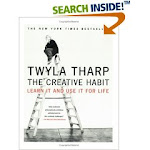
Twyla Tharp in her book The Creative Habit writes a whole chapter on failure. Like Rowling she says failure "cleanses. It helps you to put aside who you aren't and reminds you who you are."

In a useful exercise Tharp breaks down failure into five categories - it's worth reading the whole chapter, but here is a precis:

1. Failure of skill > take the time and make the effort to develop the skills you need.
2. Failure of concept > start again
3. Failure of judgement > be wary of telling yourself - it's just fine - when you know in your gut it isn't.
4. Failure of nerve > let go of the fear of looking foolish.
5. Failure through repetition > don't try and repeat past successes - allow yourself to move on.

My own epiphany with failure came when I realised the importance of scaffolding. After a house has been built, the scaffolding is removed, you don't see it -  and yet it was an essential part of the process. Likewise, ecologists trying to restore, say a wild prairie, are running into difficulties because certain species have disappeared completely and yet they were essential to arriving at the final ecosystem. From the individual species point of view, this is failing - looking at the bigger picture, they were part of the scaffolding that led to the wild prairie. Failure is scaffolding. 

This partly explains why comparison with other artists can be deadly. When I look at someone else's creative success what I don't see are the failures it took to get there. Now, when I try new things out in the studio, or in my writing, I avoid thinking - this is the final thing, this has got to work or, this is going to be the great success. I approach it like this - so, I've got a hunch to do it this way and it seems maybe a little odd or at least unexpected, but I'm going to trust myself and try it out because even if it doesn't work, who knows where it will lead? 

If I look at my favorite pages in the picture book I'm working on, they are all a third or fourth try and I wouldn't have got there if I hadn't had those 'failures' to build upon along the way. I've also tried picture books before and 'failed'. There are at least half a dozen starts in boxes and sketchbooks that didn't work out. Yet now I see that many of the ideas contained in those 'failures' are essential to this project which is coming together in a way I'm really happy about.

Failure is scaffolding, it means you are building something, trying things out, learning what works for you and what doesn't. The important thing is not the 'failure', it's using the lesson contained within to take the next step.


Tuesday, June 17, 2008

Filling the void - a cure


Sometimes, I wander around with the vague feeling that something is missing. I feel compelled to check the post, I stare around the local bookshop, waiting for that mysterious something to announce its presence - expecting of course that when I find it, the void will be filled.

But even a cheque from gallery sales arriving in the mail or the discovery of a wonderful book does not alter the disturbing feeling of absence. Thanks to a post by Susie Monday I have found the cure. It is to be more of myself.

This solution felt right, but I was unsure where this more was going to come from. I already felt like most of my life was spent being myself, making art in the studio or writing my children's book by the fire.

Clarissa Pinkola Estes explains that nurturing your psychic life involves paying attention to your dreams. My dream in brief was this. I had walked into the sea declaring my independence only to find a large fish had taken my right arm and was pulling it into it's belly. With great difficulty I managed to extricate myself. Then, still in the sea, I came across a woman with a shovel looking for potatoes. I took the shovel and found a huge stash of them.

The beauty of Active Imagination is that the characters, creatures and things in a dream speak for themselves, they tell you what they mean and what they want - which is just as well for there is no way my mind could unravel this one.

Aware that creatures in dreams are often wise and helpful beings - no matter how they first appear - and that resistance in a dream is often a reflection of the ego resisting change - I asked the fish what would have happened if it had succeeded in pulling me in.

The answer was an image of a firelit cavern with a sheet of paper waiting for me. The fish told me it was starving. I would have to earn my freedom by feeding it with a drawing. I would be freed if I promised to continue to feed it with drawings done with care and lots of detail in them.

The potatoes on the other hand told me they were all the ideas, impulses and unlived potential that was clogging up my system. What they wanted was a special box with pieces of card in it, so each one of them could be written up. In this way they would be acknowledged and honoured and the heart would have a chance to choose from among them. They didn't all need to be acted upon - just brought out into the light - given a place in the conscious life.

So there in part was my answer to the more I needed to be. There was another part to this answer involving a crazy lady archetype - but more of that in another post!